

Set shared labels and messages for your organization's hosted booking websites, while allowing individual properties to keep their own wording.
Before you start
- Confirm the organization you are signed in to. This editor changes organization wording, not only the property shown in the property selector. Selecting another property does not switch the organization whose wording you edit.
- You need Booking Engine / CRS - Settings permission to save. If controls are disabled or saving is refused, ask your organization administrator to check your access. Demonstration accounts cannot save these settings.
- Know which website, language and text you want to change. This is the shared label-and-message catalogue, not property descriptions, room descriptions or booking-policy content.
- Coordinate with other editors and start from a freshly opened form. Saving an old form can replace another person's intervening changes, including fields you did not intentionally edit.
There is no autosave. Save submits the whole wording form, including edited rows hidden by filters. Saved wording is guest-facing configuration, not a private draft. Cancel leaves without submitting your current edits; it does not undo an earlier save.
Open organization wording
- Open Admin → Home.
- In the CRS, Booking Engine, Content section, select Booking Engine Organization Settings.
- Confirm the organization name on CRS Org Settings.
- Open the Websites tab if it is not already selected.
- In the Websites section, select Wording.
- Confirm the heading Booking Engine Organization - Wording before editing.
If Booking Engine Organization Settings is not available, ask your administrator to confirm your organization's booking-engine setup and access. Do not substitute a different organization's property to find the editor.
Understand which wording wins
Wording is chosen separately for each text key and language:
- On a property's page, a saved property override takes precedence.
- Otherwise, the applicable organization override is used.
- If neither exists, the standard text is used.
On the organization's own pages, there is no property override. A property's own hosted website uses its owning organization's fallback. When a property appears on another organization's hosted website, that website's organization supplies the fallback instead.
Your organization entry is shared wherever that organization supplies the wording; it is not limited to one domain, theme or booking profile. A property-specific entry can therefore keep a property from adopting your new organization phrase. Use the property wording guide when you need an exception for one property.
Find and change a label or message
- Enter a key or phrase in Filter by key or text. For example,
Postalfinds postal-code labels. - Identify the intended row in Text.
AddressPostalCodeandCreditCardPostalCodeare different texts, even if their displayed phrases are similar. - Find the language column you want to change.
- Read the standard wording above its box.
- Enter your replacement in that language's box. For example,
ZIP Codecould replace an English postal-code label. - Preserve every placeholder, such as
{0}or{1}, exactly as written. You can move a placeholder within the sentence, but do not remove it, renumber it or change its spelling or brace contents. - Review your other edits and language columns. Clear the search and turn off Only texts with a wording of their own if you need to see all rows.
- Click Save at the top or bottom of the form.
- Read the returned message and follow Check the result below.
Use plain text, up to 2,000 characters per box. HTML and literal less-than or greater-than signs are not accepted. Leading and trailing whitespace is removed; pasted line breaks become spaces.
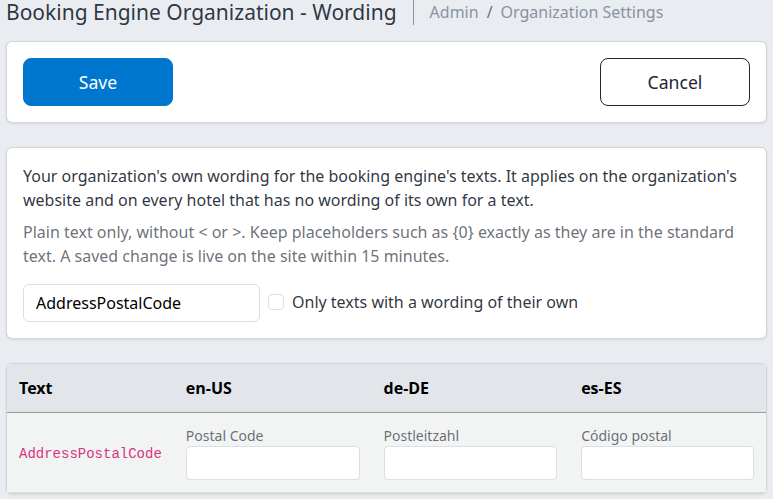
The demo editor shows the standard phrase above each empty organization box. Filtering does not change any wording. The refresh notice is explained under Check the result.
Find existing overrides
- Filter by key or text matches keys, standard text and entered organization wording across the displayed language columns. Matching is case-insensitive.
- Only texts with a wording of their own keeps rows with a nonblank organization entry in at least one displayed language. A row can qualify even when the language you are checking is blank.
- Both filters apply together. Clear the search and turn off the checkbox before concluding that a text is missing.
- The checkbox considers current inputs, including unsaved entries, when filtering runs. Typing in a wording box does not rerun the filters by itself; change the search or toggle the checkbox to refresh the selection.
- Hidden rows remain part of Save. Filters are not a way to save only one row or language.
Remove organization wording
- Find the text key and language you want to restore.
- Empty that language's box.
- Review all other pending edits, including hidden rows.
- Click Save.
- Reopen organization Wording and confirm that box is empty.
- Check the affected website and language after its wording refreshes.
An empty saved organization box means no organization override, not “display a blank label.” Spaces alone also count as empty. Clearing this entry does not remove a property's own wording; that property override still takes precedence. Without a property override, removing the organization entry restores the standard text where available.
Clearing a replacement does not recover an older organization phrase. To restore an earlier custom phrase, enter that phrase again and save.
Check the result
- After Save, read the success or validation message on the returned editor.
- Reopen Wording from the same organization's settings. Confirm that your replacement remains in the correct language box, or that a cleared box is empty. This checks saved configuration, not a guest's already-open page.
- Return through Organization Settings to Websites and open the intended website address. For a property's own website, use that property's website address instead.
- Select the affected language and visit a page that uses the text. Check both an organization page and an affected property page when your change is intended for both.
- Reload the page when checking for updated wording. Do not complete a booking, send a form or modify a reservation merely to test text.
The editor displays a 15-minute refresh notice. Hosted sites check for wording changes periodically as they serve requests; Save does not immediately refresh every site or guarantee a deadline if a refresh fails. An already-open guest page does not update automatically.
If the saved value is correct but the site differs, check the website's organization, any property override, the language and the exact text key before saving again. A catalogue entry does not establish that every theme or screen displays that text. Changing wording does not enable the feature described by it.
Field reference
| Control or value | Meaning and use |
|---|---|
| Filter by key or text | Narrows displayed rows by a key, standard phrase or current organization entry. It neither saves nor limits the submitted edits. |
| Only texts with a wording of their own | Shows rows with a nonblank organization input in at least one displayed language. It combines with the text filter. |
| Text | The key identifying the label or message, such as AddressPostalCode. Use it to distinguish similar phrases and when contacting Support. You cannot add new keys here. |
| Language headings, such as en-US, de-DE and es-ES | Shared translation-language columns derived from your organization's booking-profile languages. Regional choices can share a canonical column: the demonstrated es-MX profile language appears as es-ES in this editor. With no configured profile languages, the editor offers English. This does not add a language to a website. |
| Standard wording above a box | The standard text for that key and language, not a preview of your organization's replacement. A dash means no standard phrase is loaded for that cell. Do not assume a dash guarantees English guest-facing fallback. |
| Wording box | Your organization replacement for that key and language. Maximum 2,000 characters; plain text only. Organization boxes do not preview a property's separate override. |
| Empty wording box | No organization override. Standard text applies unless a higher-priority property override supplies the text. Empty does not hide the label. |
| Placeholders such as {0} | Values supplied when the message is displayed. Preserve their exact spelling and all required numbers; do not enter your own values in place of them. |
| Save | Validates and submits the entire form. The top and bottom buttons perform the same action. |
| Cancel | Returns to organization settings without submitting current edits. It cannot reverse saved changes. |
| Organization Settings | Returns to the organization's settings page; it is navigation, not Save. |
Common problems
Save names a key and language in a validation error
Correct the named box: remove less-than or greater-than signs, shorten an overlong entry, or restore the required numeric placeholders. A message such as plain text only, < and > are not allowed or keep the placeholders ... of the original text identifies the rule to fix.
One validation refusal prevents the wording changes in that submission from being applied. Posted values remain on the page for correction. If the standard phrase is missing for a language, placeholder validation can use English; ask Support if the expected placeholders are unclear rather than guessing.
Save fails without a wording validation message
A general processing failure is different from validation. Some changes may have saved before a later failure. Reopen the editor and compare the affected boxes before repeating the submission. If you cannot establish what saved, stop and contact Support rather than assuming the whole save was rolled back.
A language or text is missing
Clear the search and turn off Only texts with a wording of their own. Check the organization's booking-profile languages and the editor's language headings. Regional language choices can share a column. If the text or expected column is still unavailable, give Support the website, language and phrase or screen you need to change. Do not change unrelated profile languages to manufacture a column.
A property keeps its old phrase
A property override can take precedence over the organization entry. Inspect that property's wording for the same key and language. Coordinate any removal with its administrator; changing organization wording alone does not erase property exceptions. If no property override explains it, check which organization hosts the actual website and contact Support if the discrepancy remains.
Clearing a box does not restore the expected wording
Confirm that the empty box was saved for the correct organization and language. A property override or a different hosting organization's fallback may still apply. If you wanted an older custom phrase rather than the standard text, re-enter that phrase intentionally. Escalate if the actual website context does not explain the result.
The website still shows old wording
Confirm the saved value, exact key, language and website scope. Reload the affected page after the normal wording refresh; repeatedly saving unchanged values is not a refresh control. If the discrepancy persists, send Support the organization, affected property if applicable, website address, language, key, expected and displayed wording, save time/time zone and error text. Do not send passwords, payment details or guest information.